Concrete Reinforcement
IS 6461 (Part 3) — Cement Concrete: Glossary of Terms (First Revision, October 2024) · 2024 definitions.
- Auxiliary Reinforcement Cl 3.1
- In a prestressed m ember, any reinforcement in addition to the reinforcements participating in the prestressing function.
- Average Bond Stress Cl 3.2
- The force in a bar divided by the product of its perimeter and its embedded length.
- Axle Steel Cl 3.3
- Steel from carbon-steel axles for railway carriage or automobiles.
- Axle Steel Reinforcement Cl 3.4
- Plain or deformed reinforcing bars rolled from axle steel.
- Band Cl 3.5
- Small bars or wire encircling the main reinforcement in a member to form a peripheral tie.
- Band Iron Cl 3.6
- T hin metal strap used as form tie, hanger, etc.
- Bar Cl 3.7
- A metal member used to reinforce concrete.
- Bar Bender Cl 3.8
- A tradesman who cuts and bends steel reinforcement; or a machine for bending reinforcement.
- Bar Chair Cl 3.9
- A rigid device used to support and/or hold reinforcing bars in proper position to prevent displacement before or during concreting.
- Bar, Deformed Cl 3.10
- A reinforcing bar with manufactured surface deformations which provide a locking anchorage with surrounding concrete.
- Nominal Size of Deformed Bar Cl 3.10.1
- Th e nominal size of a deformed bar is equivalent to the diameter or side of a plain bar having the same weight per metre run as the deformed bar.
- Bar H ook Cl 3.11
- E nd of a reinforcing bar bent th rough 180 degree to form an anchorage.
- Bar Mat Cl 3.12
- An assembly of steel r einforcement composed of two or more layers of bars placed at angles to each other and secured together by welding or ties.
- Bar Support Cl 3.13
- See 3.9. 1 IS 6461 (Part 3) : 2024 To access Indian Standards click on the link below: https://www.services.bis.gov.in/php/BIS_2.0/bisconnect/knowyourstandards/Indian_standards/isdetails/
- Bars, Bundled Cl 3.14
- A group of not more than four parallel reinforcing bars in contact with each other, usually tied together.
- Batch Cl 3.15
- Any quantity of bars/wires of same size and strength grade and processed from an identical heat or cast, whether in coils or bundles presented for examination and test at one time.
- Bending Schedule Cl 3.16
- A list of reinforcement prepared by the designer or detailer of a reinforced concrete structure showing the shapes and dimensions of every bar and the number of bars required.
- Bent Bar Cl 3.17
- Longitudinal reinforcement bent to pass from one face to the other of a member, to use steel efficiently for resistance of moment and diagonal tension, or for anchorage of the bar.
- Billet Steel Cl 3.18
- Steel, either reduced directly from ingots or continuously cast, made from properly identified heats of open-hearth, basic oxygen, or electric furnace steel, or lots of acids Bessemer steel and conforming to specified limits on chemical composition.
- Binding Wi re Cl 3.19
- Wire used for tying reinforcing bars when fixing reinforcement.
- Bond Cl 3.20
- Adhesion and grip of concrete or mortar to reinforcement or to other surfaces against which it is placed, including friction due to shrinkage and longitudinal shear in the concrete engaged by the bar deformations; the adhesion of cement paste to a ggregate; adherence between plaster coats or between plaster and a substrate produced by adhesive or cohesive properties of plaster or supplemental materials; also in United Kingdom the arrangement of units in masonry and brickwork so that vertical joints are discontinuous.
- Bond Length Cl 3.21
- The length of grip of a reinforcing bar.
- Bond Strength Cl 3.22
- Resistance to separation of mortar and concrete from reinforcing steel and other materials with which it is in contact; a collective expression for all f orces such as adhesion, friction due to shrinkage, and longitudinal shear in the concrete engaged by the bar deformations that resist separation.
- Bond Stress Cl 3.23
- The force of adhesion per unit area of contact between two bonded surfaces, such as concre te and reinforcing steel or any other material, such as foundation rock; shear stress at the surface of reinforcing bar, preventing relative movement between the bar and the surrounding concrete.
- Bundle Cl 3.24
- Two or more coils or a number of lengths properly bound together.
- Bundled Bars Cl 3.25
- A group of parallel reinforcing bars (not exceeding four) in contact with each other and enclosed in stirrups or ties and used as a reinforcing element.
- Cage Cl 3.26
- A rigid assembly of reinforcement ready for placing in position.
- Coil Cl 3.28
- One continuous length of wire in the form of a coil.
- Cold Drawn Wire Cl 3.29
- Wire that is cold drawn from steel to increase its tensile strength.
- Cold Twisted Deformed Bar Cl 3.30
- A bar of steel produced by cold twisting a hot rolled bar and which has lugs, ribs or deformations on its surface in accordance with definitions for deformed bars in 3.10.
- Compression Reinforcement Cl 3.31
- Reinforcement designed to carry compressive stresses.
- Contact Splice Cl 3.32
- A means of connecting reinforcing bars in which the bars are lapped and are in direct contact.
- Corrosion Cl 3.33
- Disintegration or deterioration of concrete or reinforcement by electrolysis or by chemical attack.
- Corner Reinfor cement Cl 3.34
- Plaster reinforcement used at re-entrant or internal angles to provide continuity between two intersecting plaster planes; also reinforcement provided in reinforced concrete slab for torsion at unrestrained corners.
- Cover Block Cl 3.36
- Device which maintains reinforcement bars in proper position and at proper distance from each other and from the forms before and during concreting; or a device which keeps wall forms at a given distance apart before and during concreting. 2 IS 6461 (Part 3) : 2024
- Crack Cl 3.37
- Control Reinforcement — Reinforcement in concrete construction designed to prevent opening of cracks, but often effective in limiting them to uniformly distributed small cracks.
- Crimped Wire Cl 3.38
- Wire which is deformed into a curve which approximates a sine curve as a means of increasing the capacity of the wire to bond to the concrete; also welded wire fabric crimped to provide an integral chair.
- Deformed Tie Bar Cl 3.40
- Deformed bar used to hold two slab elements in close contact.
- Deformed Wire Cl 3.41
- Wire with surface characteristics to increase bond strength.
- Edge Cl 3.43
- Bar Reinforcement — Tension steel sometimes used to strengthen otherwise inadequate edges in a slab, without resorting to edge thickening.
- Effective Area of Reinforcement Cl 3.44
- The area obtained by multiplying the normal cross -sectional area of reinforcement by the cosine of the angle between the direction of the reinforcement and the direction in which the effectiveness is required.
- Effective Area of Reinforcement in Diagonal Bends Cl 3.45
- The area obtained by multiplying the normal cross-sectional area of the reinforcement by the cosine of the angle at which the band is inclined to the direction for which its effectiveness is considered.
- Effective Reinforcement Cl 3.46
- Reinforcement of a section assumed to be active in resisting the applied stresses.
- Elastic Limit Cl 3.47
- The limit of stress beyond which the strain is not wholly recoverable.
- Expanded Metal Cl 3.48
- A metal network, often used as reinfor cement in concrete construction, formed by suitably stamping or cutting sheet metal and stretching it to form open meshes, usually of diamond shape.
- Field Bending Cl 3.49
- Bending of reinforcing bars on the job rather than in a fabricating shop.
- Hairpin Cl 3.50
- A light hairpin shaped reinforcing bar used for shear reinforcement in beams, tie reinforcement in columns, or prefabricated column shear heads.
- Hard Drawn Wire Cl 3.51
- Wire that has been drawn through die at normal temperature.
- Heavy Cl 3.52
- edge Reinforcement — Wire fabric reinforcement, for highway pavement slabs, having one t o four edge wires heavier than t he other longitudinal wires.
- High Strength Steel Cl 3.54
- Steel with a high yield point; in the case of reinforcing bars generally greater than 42 kgf/mm2.
- High Tensile Steel Cl 3.55
- Alloy steel having a tensile strength of not less than 980 N/mm2.
- Hook Cl 3.56
- A bend in the end of a reinforcing bar.
- Hooked Bar Cl 3.57
- A reinforcing bar with the end bent into a hook to provide anchorage.
- Indented W ire Cl 3.58
- Deformed wire that has indentations.
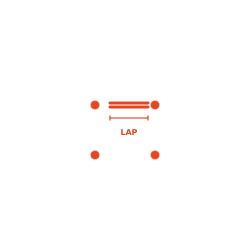
- Lap Cl 3.59
- The length by which one bar or sheet of fabric reinforcement overlaps another.
- Lapping Cl 3.60
- The overlapping of reinforcing s teel bars, welded wire fabric, or expanded metal so that there may be continuity of tensile or compressive stress in the reinforcing bar when the concrete member is subjected to flexural or tensile or compressive loading.
- Lap Splice Cl 3.61
- A connection of reinforcing steel made by lapping the ends of the bars.
- Lateral Reinforcement Cl 3.62
- Usually applied to the transverse hoops, links, or helical reinforcement in columns.
- Load Transfer Assembly Cl 3.63
- Most commonly, the unit (basket or plate) designed to support or link dowel bars during concreting operations so as to hold them in place, in the desired alignment.
- Longitudinal Bar Cl 3.64
- Reinforcement essentially parallel to the long axis of a concrete member or pavement.
- Main Bar Cl 3.66
- Steel reinforcement designed to resist stresses resulting from design loads and moments, as opposed to reinforcement intended to resist secondary stresses. Also, this is reinforcement that distributes main structural forces. 3 IS 6461 (Part 3) : 2024
- Mechanical Bond Cl 3.69
- T he bond between concrete and reinforcing bars, attributed to keying or interlocking action other than adhesion.
- Mesh Cl 3.70
- A series of longitudinal and transverse wires arranged substantially at right angles to each other and welded together at all points of intersection.
- Mesh Reinforcement Cl 3.71
- Welded-wire fabric in either sheets or rolls, used to reinforce concrete.
- Mill Scale Cl 3.72
- The oxide layer formed during the hot rolling of metals, such as that formed on hot- rolled reinforcing bars.
- Negative Reinforcement Cl 3.73
- Steel r einforcement for negative moment.
- Non Cl 3.74
- prestressed Reinforcement — Or dinary or high tensile strength reinforcing steel, as used in prestressed concrete construction, and subjected to no prestressing nor post-tensioning.
- Offset Bend Cl 3.75
- Any bend in a reinforcing bar that displaces the centre line of a section of the bar to a position parallel to the original bar, in which the displacement is relatively sma ll; commonly applied to column verticals.
- Pencil Rod Cl 3.76
- Plain metal rod of about 6 mm diametre.
- Plain Bar Cl 3.77
- A reinforcing bar without surface deformations, or one having-deformations that do not conform to the applicable requirements.
- Positive Reinforcement Cl 3.78
- R einforcement for positive moment.
- Proof Stress Cl 3.79
- The stress ‘ which is just’ sufficient to produce, under load, a non-proportional elongation equal to a specified percentage of the original gauge length; conventionally the specified percentage is fixed at 0.1 percent or 0.2 percent . IS 1786 specifies this limit as 0.2 percent.
- Rail Steel Reinforcement Cl 3.80
- Reinforcing bars hot-rolled from standard T-section rails.
- Reinforcement Cl 3.81
- Metal bars, wires, or other s lender members which are embedded as percentage of concrete in such a manner that the metal and the concrete act together in resisting forces.
- Reinforcement, Cold Cl 3.83
- Drawn Wire — Steel wire made from rods that have been hot rolled from billets, cold-drawn through a die; for concrete r einforcement of small diameter, such as in sizes not less than 2 mm nor greater than 16 mm.
- Reinforcement, Cold Cl 3.84
- Worked Steel — Steel bars or wires which have been rolled, twisted, or drawn at normal ambient temperatures.
- Reinforcement, Corner Cl 3.85
- Metal reinforcement for plaster reentrant corners to provide continuity between two intersecting planes; or concrete reinforcement used at wall intersections or near corners of square or rectangular openings in walls, slabs, or beams.
- Reinforcement Coupler Cl 3.86
- Coupling sleeve or threaded coupler for mechanical splices of reinforcement bars for the purpose of providing transfer of axial tensile force and/or compressive force from one bar to the other, where: a) coupling sleeve is a device fitting over the ends of two reinforcing bars; and b) threaded coupler is a threaded device for joining reinforcing bars with matching threads.
- Reinforcement, Crack Cl 3.87
- Control — R einforcement concrete construction designed to minimize opening of cracks, often effective in limiting them to uniformly distributed small cracks.
- Reinforcement Displacement Cl 3.88
- Mo vemen t of reinforcing steel from its specified position in the forms.
- Reinforcement, Distribution Bar Cl 3.89
- S mall- diameter bars, usually at right angles to the main reinforcement, intended to spread a concentrated load on a slab and to prevent cracking.
- Reinforcement, Dowel Cl 3.90
- Bar — Short bars, extending approximately equally into two abutting pieces of concrete, to increase the strength of the joint.
- Reinforcement, Expanded Metal Fabric Cl 3.91
- A form of reinforcement made by slitting a rolled steel sheet and then stretching it to form a diamond- shaped mesh.
- Reinforcement, Four Cl 3.92
- Way — A system of reinforcement in flat slab construction comprising bands of bars parallel to two adjacent edges and also to both diagonals of a rectangular slab. 4 IS 6461 (Part 3) : 2024
- Reinforcement Chair Cl 3.82
- Device to support the top layer of reinforcement for a concrete slab.
- Reinforcement, Helical Cl 3.93
- Steel reinforcement forming a helix.
- Reinforcement, High Tensile Cl 3.94
- Concrete reinforcing bars having a minimum yield strength or 0.2 percent proof stress above a specified value, such as 42 kgf/mm2 or 52 kgf/mm2.
- Reinforcement, Hoop Cl 3.95
- Binders in the form of rings ( other than helical) round the main reinforcement in columns and piles.
- Reinforcement, Lateral Cl 3.96
- Usually applied to the transverse hoops, links, or helical reinforcement in columns.
- Reinforcement, Mesh Cl 3.97
- An arrangement of bars or wire normally in two directions at right angles, tied or welded at the intersections, or interwoven (see also 3.92).
- Reinforcement Ratio Cl 3.98
- Ratio of the effective area of the reinforcement to the effective area of the concrete at any section of a structural member.
- Reinforcement, Secondary Cl 3.99
- Reinforcement other than main reinforcement.
- Reinforcement, Spiral Cl 3.100
- Coiled wire or bar held to a definite pitch or spacing.
- Reinforcement, Twin Cl 3.102
- Twisted Bar — Two bars of the same nominal diameter twisted together.
- Reinforcement, Two Cl 3.103
- Way — Reinforcement arranged in bands of bars at right angles to each other.
- Reinforcement, Welded Cl 3.104
- Reinforcement joined together by welding.
- Relaxation (of Steel) Cl 3.105
- Decrease in stress in steel as a result of creep within the steel under prolonged strain; decrease in stress in steel as a result of decreased strain of the steel, such as results from shrinkage and creep of the concrete in a prestressed concrete unit.
- Seven Cl 3.106
- Wire Strand — Any length of finish ed material which comprises six wires spun together in helical form around a central wire.
- Shear Reinforcement Cl 3.107
- Reinforcement designed to resist shear or diagonal tension stresses; dowels are not considered to be shear reinforcement.
- Shrinkage Reinforcement Cl 3.108
- Reinforcement designed to resist shrinkage stresses in concrete.
- Slab Spacer Cl 3.109
- Bar support and spacer for slab rein forcement.
- Spacer Cl 3.110
- Device which maintains reinforcement in proper position, or wall forms at a given distance apart before and during concreting.
- Spiral Reinforcement Cl 3.111
- See 3.100.
- Splice Cl 3.112
- Connection of one reinforcing bar to anoth er by overlapping, welding, mechanical end connectors, or other means.
- Standard H ook Cl 3.113
- A hook at the end of a reinfor cing bar made in accordance with a standard.
- Stirrup Cl 3.114
- A reinforcing device to resist shear and diag onal tension stresses in a beam, typically a steel bar bent into a U-shape and installed perpendicular to or at an angle to the longitudinal reinforcement, and properly anchored.
- Strand Cl 3.115
- A prestressing tendon composed of a numb er of wires most of which are twisted about a centre wire or core.
- Stress Corrosion Cl 3.116
- Corrosion of a metal accelerated by stress.
- Temperature Reinforcement Cl 3.117
- Reinforce ment designed to carry stresses resulting from temperature changes; also the minimum reinforcement for areas of members which are not subjected to primary stresses or necessarily to temperature stresses.
- Tensile Strengths Cl 3.118
- The maximum load reached in a tensile test divided by the original cross- sectional area of the gauge length portion of the test piece. Also termed as maximum stress, or ultimate tensile stress.
- Tension Reinforcement Cl 3.119
- Reinforcement designed to carry tensile stresses such as those in the bottom of a simple supported beam.
- Three Cl 3.120
- Wire Strand — Any length of finished material which comprises three wires spun together in helical form.
- Tie Cl 3.121
- Closed loop of reinforcing bars encircling the longitudinal steel in columns; also a 5 IS 6461 (Part 3) : 2024 tensile unit which holds concrete formwork secure against lateral pressure of unhardened concrete.
- Tie Bar Cl 3.122
- A deformed bar embedded in a concrete construction at a joint and designed to hold abutting edges together, but not designed for direct load transfer as a dowel.
- Transverse Reinforcement Cl 3.123
- Reinforcement at right angles to the principal axis of a member.
- Twin Cl 3.124
- Twisted Reinforcement — See 3.102.
- Two Way Reinforcement Cl 3.125
- Reinforcement for a concrete slab consisting of bands or reinforcing bars at right angles to each other.
- Two Cl 3.126
- Wire Strand — Any length of finished material which comprises two wires spun together in helical form.
- Web Bar Cl 3.127
- Reinforcement placed in a concrete member to resist shear and diagonal tension.
- Web Reinforcement Cl 3.128
- See 3.127.
- Welded Cl 3.129
- Butt Sp lice — A reinforcing bar splice made by welding the butted ends.
- Welded Cl 3.130
- Wire Fabric — A series of longitudinal and transverse wires arranged substantially at right angles to each other and welded together at all points of intersection.
- Welded Cl 3.131
- Wire Fabric Reinforcement — Welded-wire fabric in either sheets or rolls, used to reinforce concrete.
- Wire, Cold Cl 3.132
- Drawn — Wire made from the rods hot rolled from billets and then cold -drawn through dies.
- Wire Mesh Cl 3.133
- See 3.130.
- Woven Cl 3.134
- Wire Fabric — A prefabricated steel reinforcement composed of cold -drawn steel wires mechanically twisted together to form hexagonally shaped openings.
- Woven Cl 3.135
- Wire Reinforcement — See 3.130.
- Yield Point Cl 3.136
- That point during increasing stress wh en the proportion of stress to strain becomes substantially less than it has been at smaller values of stress.
- Yield Strength Cl 3.137
- The stress, less than the maximum attainable stress, at which the ratio of stress to strain has dropped well below its value at low stress, or at which a material exhibits a specified limiting deviation from the usual proportionality of stress to strain.
- Yield Stress Cl 3.138
- Stress (that is, load per unit cross-sectional area) at which elongation first occurs in the test -piece without increasing the load during tensile test. In the case of steels with no such definite yield point, the yield stress is the stress under the prescribed testing conditions at which the observed increase in the gauge length is 1/200 of the gauge length when the rate at which the load is applied is not more than 0.5 kg/mm 2/s when approaching the yield stress.


See alsoColumn Capacity


See alsoBBS / Cutting Length

See alsoRebar Inspection

Note — IS 1786 define the deformed bar as a bar of steel provided with lugs, ribs or deformations on the surface of the bar to minimize the slippage of the bar in concrete, and for which the bond strength calculated from the load at a measured slip of 0.025 mm in accordance with IS 2770 (Part 1) exceeds that of a plain round bar of the same nominal size by 40 percent or more.


See alsoFormwork Pressure


See alsoColumn Capacity


See alsoCube Test Statistics

See alsoColumn Capacity


See alsoBBS / Cutting Length


See alsoRebar Inspection


See alsoBBS / Cutting Length


See alsoBBS / Cutting Length


See alsoColumn Capacity


See alsoBBS / Cutting Length


See alsoCube Test Statistics


See alsoBBS / Cutting Length


See alsoBBS / Cutting Length


See alsoColumn Capacity


See alsoLap Length


See alsoCuring Water


See alsoBBS / Cutting Length

See alsoBBS / Cutting Length

See alsoColumn Capacity


See alsoCube Test Statistics


See alsoBBS / Cutting Length

See alsoBBS / Cutting Length


See alsoCube Test Statistics

See alsoColumn Capacity
Rights & fair use. All definitions on this page are the property of the Bureau of Indian Standards (© BIS 2024), reproduced from IS 6461 (Part 3) : 2024, Cement Concrete — Glossary of Terms (First Revision). They are shared here in good faith, solely as technical reference for individual members of the civil engineering fraternity; this is not a BIS publication and no ownership is claimed. For authoritative or contractual use, purchase the official PDF at bis.gov.in. The printed standard prevails over any text-extraction artefact.