
Column Capacity Calculator

Factored axial capacity of a short braced RC column per IS 456:2000 Cl 39.3 — with the Cl 25.4 minimum-eccentricity and slenderness gates that decide whether the shortcut applies at all.
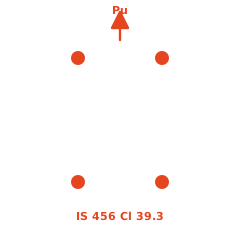
Column capacity — column cross-section with four corner rebars, stirrup outline, and axial load Pu

0 if unknown

Gross area Aₗ
mm²
Steel Asc
mm² (%)
eₘₐₗ per Cl 25.4
mm
Slenderness l/min-dim
(≤ 12 short)
Concrete share of Pu
%

Steel below the 0.8% minimum of Cl 26.5.3.1 — increase bars or diameter.

Above 4% steel — laps need special detailing per Cl 26.5.3.1.

How this is calculated

IS 456:2000 Cl 39.3 (Reaffirmed 2021): Pu = 0.4·fck·Ac + 0.67·fy·Asc, with Ac = gross area minus steel. Two gates guard the shortcut: the load eccentricity must sit within the Cl 25.4 minimum, max(l/500 + D/30, 20 mm), and the column must be short (effective length over least dimension ≤ 12). Steel must stay between 0.8% and 6% of gross per Cl 26.5.3.1.

When a gate fails, the calculator prints the reason instead of a number: eccentric columns need Cl 39.4/39.5 combined bending design, slender ones Cl 39.7 additional moments. A number you can’t trust is worse than no number — and concrete is unforgiving of guessed columns.

Worked example

Given: 300 × 300 mm column, M25, Fe500, 6–16 mm bars, 3.0 m effective length, concentric load.

Gates: eₘₐₗ = max(3000/500 + 300/30, 20) = 20 mm ≥ e ✓; slenderness 3000/300 = 10 ≤ 12 ✓; steel 1206/90,000 = 1.34% (0.8–6% ✓)

Pu = 0.4×25×88,794 + 0.67×500×1206 = 888 + 404 = 1292 kN

Service load = 1292/1.5 = 861 kN — for the concentric ideal; frame moments reduce what the same column safely carries.

FAQ

Why 0.4 fck and 0.67 fy — not the usual 0.45 and 0.87?

Those are the coefficients of IS 456 Cl 39.3 itself for axially loaded short columns: they fold in the material partial safety factors plus the fact that a tied column’s steel cannot reach its full design stress at the concrete’s ultimate strain. Use them exactly as published — do not rebuild them from the flexural values.

When does the Cl 39.3 shortcut NOT apply?

Two gates. First, eccentricity must stay within the Cl 25.4 minimum — max(l/500 + D/30, 20 mm); anything more eccentric needs the combined axial + bending design of Cl 39.4/39.5. Second, the column must be short: effective length over least lateral dimension ≤ 12. Slender columns carry additional moments per Cl 39.7 and buckle below this capacity. This calculator refuses to print a number when either gate fails.

Why is steel limited to 0.8% minimum and 6% maximum?

Below about 0.8% a column behaves closer to plain concrete — a sudden brittle failure with almost no warning; the minimum steel keeps some ductility and controls thermal and creep strains. Above 6%, congestion prevents proper compaction around bars, so IS 456 Cl 26.5.3.1 caps it — with 4% the practical ceiling where bars are lapped.

Is the result the load I can put on the column?

The calculator reports the factored capacity Pu and the service load Pu/1.5 — the safe long-term working load for a perfectly concentric, braced, short column. Real columns carry moments from frame action and imperfection; the design engineer must confirm the whole load path, not just this axial number.

§ 99

Calculator companions

Often used together with this calculator — pick the next step in your design or QA loop.

Visualisation

Indicative tool — not a substitute for engineering judgement. Results are computed from formulae and reference values cited to Indian Standards and other published codes as named on this page, using nominal default assumptions; clause and table references are given in good faith for study and preliminary checks. Always verify the current edition and amendments of any cited standard in the BIS catalogue before relying on it. Final mix proportions, structural checks and construction decisions must be confirmed by a qualified engineer against the project design brief, drawings and site conditions. ConcreteInfo accepts no liability for design, procurement or construction decisions taken on the basis of these tools. Code references & rights: Indian Standards are the property of the Bureau of Indian Standards (© BIS) — official PDFs at bis.gov.in. Shared in good faith as technical reference for the civil engineering fraternity — always verify against the official publication.

Deep dive: read the full significance guide — the code clauses, assumptions and site meaning behind these numbers.

§ 99

Calculator companions

Often used together with this calculator — pick the next step in your design or QA loop.