Rebar Weight Calculator

Weight of TMT reinforcement from bar diameter — the IS 1786 nominal-mass basis (d²/162.2 from a steel density of 7850 kg/m³). Enter diameter, cut length and number of bars.

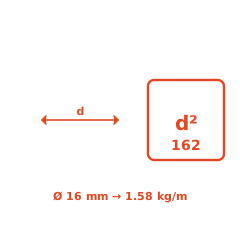
Rebar weight — rebar cross-section with diameter line and the d²/162 formula

Common TMT: 8, 10, 12, 16, 20, 25, 32 mm

IS 1786 nominal mass (kg/m)

8 mm0.395
10 mm0.617
12 mm0.888
16 mm1.578
20 mm2.466
25 mm3.854
32 mm6.316

Steel weight

kg ( t)

Unit weight
kg/m
Weight per bar
kg
Bars computed
nos

How this is calculated

Mass per metre is the bar’s cross-section times the density of steel: (π/4) d² × 7850 kg/m³. With d in millimetres this collapses to d²/162.2 kg/m — the nominal-mass basis of IS 1786:2008 (12 mm → 0.888 kg/m, 16 mm → 1.578 kg/m, matching the standard’s table). Total weight is unit weight × cut length × number of bars.

The figure is nominal: IS 1786 permits small mass tolerances on individual bars and batches, so a weighbridge will differ slightly. Order procurement on the nominal figure and reconcile tolerance-band deviations with the supplier.

Worked example

Given: a beam needs 100 nos of 12 mm bars, each cut to 12 m.

Unit weight = 12²/162.2 = 0.888 kg/m

Weight per bar = 0.888 × 12 = 10.65 kg

Total = 10.65 × 100 = 1,065 kg ≈ 1.07 tonnes — before laps and wastage, which your bar bending schedule (see the BBS calculator) adds separately.

FAQ

Why divide d squared by 162.2?

Mass per metre = cross-section area x density = (π/4)d² x 7850 kg/m³. Working in mm and kg, that collapses to d²/162.2 — 12 mm gives 144/162.2 = 0.888 kg/m, exactly the nominal mass in IS 1786:2008.

Does Fe500 or Fe550D bar weigh more than Fe415?

No. The nominal mass depends only on the nominal diameter and the 7850 kg/m³ steel density, which are the same for every grade. Strength grade changes the stress the bar carries, not its weight.

Why does the weighbridge reading differ slightly from this calculation?

IS 1786 permits small mass tolerances on individual bars and batches against the nominal mass, and rolled bars vary within them. Order and reconcile steel on the nominal figure; investigate only deviations beyond the standard’s tolerance.

Do the ribs and lugs on TMT add weight?

The nominal mass is defined on the nominal diameter, and the rib geometry is controlled so the mass stays within the standard’s tolerance. No rib allowance is added in bar-by-bar estimates.

§ 99

Calculator companions

Often used together with this calculator — pick the next step in your design or QA loop.

Visualisation

Indicative tool — not a substitute for engineering judgement. Results are computed from formulae and reference values cited to Indian Standards and other published codes as named on this page, using nominal default assumptions; clause and table references are given in good faith for study and preliminary checks. Always verify the current edition and amendments of any cited standard in the BIS catalogue before relying on it. Final mix proportions, structural checks and construction decisions must be confirmed by a qualified engineer against the project design brief, drawings and site conditions. ConcreteInfo accepts no liability for design, procurement or construction decisions taken on the basis of these tools. Code references & rights: Indian Standards are the property of the Bureau of Indian Standards (© BIS) — official PDFs at bis.gov.in. Shared in good faith as technical reference for the civil engineering fraternity — always verify against the official publication.

Deep dive: read the full significance guide — the code clauses, assumptions and site meaning behind these numbers.