BBS Cutting Length Calculator

Cutting lengths and steel weights for bar bending schedules per IS 2502:1963 — stirrups, seismic stirrups (IS 13920), hooked bars — with the method stated for every result.

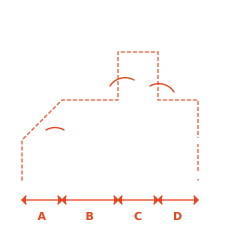
BBS cutting length — stirrup-shaped rebar with bend-deduction offset and segment labels

Cutting length per bar

mm

order length mm (next whole 25, Cl 5.1.1)

Unit weight
kg/m
Weight per bar
kg
Total ( bars)
kg

Method:

How this is calculated

Unit weight: ز/162 kg/m — the nominal mass basis (7850 kg/m³ steel). Actual delivered weight varies with rolling tolerance; our rolling margin calculator covers that check.

Stirrups: IS 2502 Table VIII gives the rectangular stirrup cutting length directly as 2(A+E) + 24d from the scheduled external dimensions. For ductile-detailing zones, IS 13920 Cl 8.1(b) requires 135° hooks with a straight extension of 10d (≥ 75 mm) — the seismic option adds 2 × max(10d, 75) to the stirrup body, the standard site convention for that case.

Hooks and bends: IS 2502 Table II adds an allowance to scheduled dimensions per hook (H = 9d / 11d / 13d / 17d for steel factor k = 2 / 3 / 4 / 6) and per bend (B = 5d – 7d), each rounded to 5 mm with a 75 mm minimum. IS 2502 Cl 3.8 separately requires the straight portion beyond a stirrup's end curve to be at least 8d.

Verified against the IS 2502:1963 BIS PDF — see our verified constants table.

Why you may see different answers elsewhere

Most BBS tutorials tell you to deduct 2d per 90° bend and 3d per 135° bend. That shortcut belongs to the centerline-measurement convention — you measure leg lengths along the bar's centreline and subtract the bend geometry. It is not in IS 2502. The code instead works from scheduled external dimensions and adds Table II allowances. Both conventions produce sensible numbers; they just must not be mixed. This calculator uses the IS 2502 method for code shapes and says so on every result card.

Worked example

Given: column stirrup for a 300×450 member with 40 mm cover → A = 220, E = 370 (external), Ø8, 25 nos.

IS 2502 Table VIII: cutting = 2(220+370) + 24×8 = 1180 + 192 = 1372 mm → order 1375 mm

Weight = 0.395 kg/m × 1.372 m = 0.54 kg per bar → 13.5 kg for 25 stirrups

Seismic variant: 2(590) + 2×80 = 1340 mm (135° hooks, 10Ø = 80 ≥ 75 mm extensions)

FAQ

What is the deduction for a 90° bend?

Under the popular centerline convention: 2d. Under IS 2502's allowance method: there is no deduction — you add Table II allowances to external dimensions instead. Pick one convention per schedule and stay with it; this tool uses IS 2502.

Which hook do stirrups need in seismic zones?

135° hooks with a 10d (≥75 mm) straight extension into the confined core (IS 13920). A 90° hook straightens when cover spalls in an earthquake — exactly when the stirrup must hold.

Why ز/162 for unit weight?

Mass = π/4 × Ø² × 7850 kg/m³ = 0.00617 ز ≈ ز/162. It is the nominal cross-section value; rolling tolerance means delivered weight differs — which is what the rolling margin check is for.

§ 99

Calculator companions

Often used together with this calculator — pick the next step in your design or QA loop.

Visualisation

Indicative tool — not a substitute for engineering judgement. Results are computed from formulae and reference values cited to Indian Standards and other published codes as named on this page, using nominal default assumptions; clause and table references are given in good faith for study and preliminary checks. Always verify the current edition and amendments of any cited standard in the BIS catalogue before relying on it. Final mix proportions, structural checks and construction decisions must be confirmed by a qualified engineer against the project design brief, drawings and site conditions. ConcreteInfo accepts no liability for design, procurement or construction decisions taken on the basis of these tools. Code references & rights: Indian Standards are the property of the Bureau of Indian Standards (© BIS) — official PDFs at bis.gov.in. Shared in good faith as technical reference for the civil engineering fraternity — always verify against the official publication.

Deep dive: read the full significance guide — the code clauses, assumptions and site meaning behind these numbers.