
Crack Injection Quantity Calculator

Epoxy or polyurethane resin, injection packers and surface-seal putty for concrete crack repair — from crack length, width and depth with a loss allowance. Transparent arithmetic, editable typical values, no code citation (none governs injection consumption).
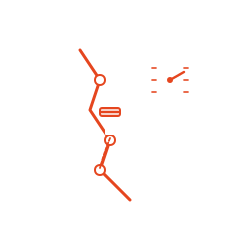
Crack injection quantity — wall with zig-zag crack, three injection ports and a pressure gauge

Measure at several points with a crack gauge and average.

Member thickness for through cracks; drilled depth for deep ports.

Typical 200–300 mm — closer for fine cracks.

Materials required

kg resin

Crack void volume
L
Injection packers
nos
Surface-seal putty
kg

How this is calculated

Crack void volume = length × average width × depth, modelled as a rectangular void. Resin mass = void volume × resin density × (1 + loss allowance). Packers = crack length ÷ port spacing, rounded up, plus one. Surface-seal putty = crack length × 0.16 kg/m (a 50 × 2 mm strip at 1.6 kg/L).

No IS code governs injection consumption — density, loss and spacing here are editable typical site-practice values. Resin systems vary; verify against your manufacturer datasheet, and measure crack width honestly — at 0.3 mm the resin demand is one-sixth of a 2 mm crack.

Worked example

Given: dormant slab crack, 3 m long, 0.3 mm average width, 200 mm deep (through), epoxy at 1.10 kg/L, 15% loss, ports at 250 mm.

Void = 3 × 0.0003 × 0.2 = 0.18 L

Resin = 0.18 × 1.10 × 1.15 = 0.23 kg (one small kit covers it)

Packers = 3000/250 = 12 → +1 = 13 nos · putty = 3 × 0.16 = 0.48 kg

FAQ

How much epoxy for a 3 m crack, 0.3 mm wide, 200 mm deep?

Void = 3 × 0.0003 × 0.2 = 0.18 L → resin = 0.18 × 1.10 × 1.15 = 0.23 kg. Packers at 250 mm = 13, putty = 0.48 kg. Fine cracks consume surprisingly little resin — the consumables (packers, putty, cleaner) often cost more than the resin itself.

Epoxy or polyurethane — which one?

Low-viscosity epoxy bonds and restores structural continuity across dormant cracks and needs a reasonably dry crack. Polyurethane reacts with water and foams — it suits moving or water-bearing cracks and leak-sealing. If the crack is live (thermal/structural movement), injecting rigid epoxy will re-crack it.

Why 15% injection loss?

Resin stays in the packer body, soaks into the surface seal and the crack flanks near the mouth, and some purges at the adjacent port when it flashes. 15% is a typical planning figure — editable here. Very rough concrete surfaces or wide, branching cracks can take more.

How is port spacing decided?

Ports are spaced so resin reaches the next port before the injection pressure peaks — typically 200–300 mm, closer for hairline cracks (higher viscosity travel resistance) and wider for open cracks. For through-cracks, ports alternate face; the calculator counts total packers along the length, so stagger them on both faces.

§ 99

Calculator companions

Often used together with this calculator — pick the next step in your design or QA loop.

Visualisation

Indicative tool — not a substitute for engineering judgement. Results are computed from formulae and reference values cited to Indian Standards and other published codes as named on this page, using nominal default assumptions; clause and table references are given in good faith for study and preliminary checks. Always verify the current edition and amendments of any cited standard in the BIS catalogue before relying on it. Final mix proportions, structural checks and construction decisions must be confirmed by a qualified engineer against the project design brief, drawings and site conditions. ConcreteInfo accepts no liability for design, procurement or construction decisions taken on the basis of these tools.

Deep dive: read the full significance guide — the code clauses, assumptions and site meaning behind these numbers.

§ 99

Calculator companions

Often used together with this calculator — pick the next step in your design or QA loop.