
Cube Test Statistics & Acceptance

Enter your 28-day cube results and grade — get mean, standard deviation, CV and the full IS 456:2000 Table 11 (Amendment 4) conformity verdict: groups of four, individual limits, and small-pour criteria.
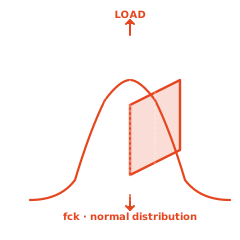
Cube test statistics — concrete cube under compressive load with a normal-distribution bell curve

Comma, space or newline separated. Groups of four are taken consecutively from the top.

IS 456 Table 11 verdict

Results / mean / σ
/ / N/mm²
Coefficient of variation
%
σ used
()
Group-of-4 mean limit
Individual limit
Group means

How this is calculated

Mean and sample standard deviation (σ, n−1 basis) come straight from your numbers. Acceptance follows IS 456:2000 Table 11 as amended through Amendment 4: each group of four non-overlapping consecutive results must average at least fck + max(0.825σ rounded to the nearest 0.5, 3), and every individual result must be at least fck − 3. For pours of 30 m³ or less with fewer than four samples, Note 2 applies: mean ≥ fck + 4 and individual ≥ fck − 2.

The σ used is your established value if entered; otherwise the assumed values of Table 8 apply — 3.5 (M10–M15), 4.0 (M20–M25), 5.0 (M30+) N/mm² — which the code permits until a site σ from 30+ results is established.

Worked example

Given: M25, results 34, 36, 38, 33 N/mm² (one group of four), no established σ → Table 8 σ = 4.0.

Mean = 35.25; sample σ = 2.22; CV = 6.3%

Group limit = 25 + max(round½(0.825 × 4.0), 3) = 25 + max(3.5, 3) = 28.5 → 35.25 ≥ 28.5 ✓

Individual limit = 25 − 3 = 22 → minimum 33 ≥ 22 ✓ → conforms

FAQ

Why a group of four, and in what order?

IS 456 judges conformity on the mean of four non-overlapping consecutive results — consecutive in order of sampling, so the check tracks production over time, not a hand-picked set. Enter results in the order the cubes were cast; this tool slices them into groups of four from the top.

When can I stop using the assumed standard deviation?

Once you hold 30 or more results for the grade and plant, compute the actual σ and enter it — a well-controlled plant typically shows σ of 2–4 N/mm², comfortably below the assumed 4.0–5.0, which relaxes the group-mean limit and rewards good control.

My pour was only 22 m³ and I have 2 results — which limits apply?

Table 11 Note 2: for concrete quantity up to 30 m³ where fewer than four samples are taken, the mean must be at least fck + 4 and each individual result at least fck − 2. Tick the small-pour box to apply these limits. A single sample must itself be at least fck + 4.

What happens when a result fails?

A failed Table 11 check does not automatically mean rejection: IS 456 Cl 16.4 permits investigation of the actual structure — typically non-destructive testing (UPV, rebound hammer) or core extraction per IS 516 Part 4 / IS 456 Cl 17. The failure report should trigger an investigation of batching, sampling and testing before any removal decision.

§ 99

Calculator companions

Often used together with this calculator — pick the next step in your design or QA loop.

Visualisation

Indicative tool — not a substitute for engineering judgement. Results are computed from formulae and reference values cited to Indian Standards and other published codes as named on this page, using nominal default assumptions; clause and table references are given in good faith for study and preliminary checks. Always verify the current edition and amendments of any cited standard in the BIS catalogue before relying on it. Final mix proportions, structural checks and construction decisions must be confirmed by a qualified engineer against the project design brief, drawings and site conditions. ConcreteInfo accepts no liability for design, procurement or construction decisions taken on the basis of these tools. Code references & rights: Indian Standards are the property of the Bureau of Indian Standards (© BIS) — official PDFs at bis.gov.in. Shared in good faith as technical reference for the civil engineering fraternity — always verify against the official publication.

Deep dive: read the full significance guide — the code clauses, assumptions and site meaning behind these numbers.