Concrete Temperature Calculator — Placement T & Adiabatic Rise

Two tabs. Tab A estimates the fresh-concrete placement T using the ACI 305R mass-weighted formula (the lever the plant actually controls is the mixing water T, not the cement T). Tab B sizes the adiabatic peak T and the core-vs-surface ΔT for mass concrete per ACI 207.2R — flagging 70 °C peak / 20 °C ΔT limits.

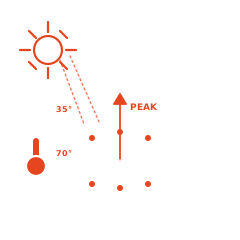
Concrete temperature — thermometer with sun and cloud over a concrete element

Concrete Temperature

Component temperatures (°C)

Component masses (kg per m³ batch)

Replaces part of mixing water; reduces placement T via latent heat of fusion.

Placement T

°C

IS 456 ≤ 40°C ACI 305R ≤ 35°C

Peak core T (≈ age)

°C

Rise above placing T
°C
ΔT vs surface (approx)
°C
Time to 50 % peak
days
Element class
Peak T ≤ 70°C ΔT ≤ 20°C

How this is calculated

Placement T (Tab A): ACI 305R-10 Appendix A specific-heat-ratio formula T = (0.22·(T_ag·M_ag + T_c·M_c) + T_w·M_w + T_wa·M_wa − M_ice·79.7) / (0.22·(M_ag + M_c) + M_w + M_wa − M_ice). The 0.22 is the ratio of cement+aggregate specific heat to water. Cooling mixing water or substituting crushed ice pulls placement T down fastest.

Adiabatic rise (Tab B): Single-exponential T(t) = T_ult × retention × (1 − e−α·t). T_ult derives from total heat of hydration (OPC ~90, fly ash ~45, GGBS ~60 kcal/kg binder) divided by heat capacity of concrete (~2.30 kJ/K per m³). The retention factor and α rate constant depend on element thickness (heat loss to ambient).

Limits cited: ACI 305R placement T ≤ 35 °C; IS 7861-1 Cl 2.1 placement T ≤ 40 °C; ACI 207.2R §5.6 + ACI 207.2R peak T ≤ 70 °C and core-vs-surface ΔT ≤ 20 °C for mass concrete.

Worked example

Placement T: Pune summer pour, ambient 38 °C; aggregate 42 °C; cement 75 °C (bulk storage in sun); mixing water 28 °C; 400 kg/m³ cement, 1900 kg/m³ aggregate, 160 L/m³ water. num = 0.22·(42·1900 + 75·400) + 28·160 = 17556 + 4480 = 22036; den = 0.22·2300 + 160 = 666; T = 22036 / 666 = 33.1 °C — within ACI 305R limit, well within IS 456.

Adiabatic rise (mass raft): 2.5 m thick raft, 400 kg/m³ OPC, placing T 30 °C. T_ult = 90·400 / (2400·0.96) × 4.184 ≈ 65 °C theoretical; retention 0.90 for 2.5 m; peak rise ≈ 58 °C; peak T ≈ 88 °C — exceeds 70 °C limit. Switch to 30 % fly ash → T_ult drops to ~52 °C, retention 0.90, peak rise ≈ 47 °C, peak T ≈ 77 °C — still over. Try 50 % fly ash + low-heat cement.

FAQ

What is the ACI 305R placement temperature formula?

T = (0.22·(T_ag·M_ag + T_c·M_c) + T_w·M_w + T_wa·M_wa − M_ice·79.7) / (0.22·(M_ag + M_c) + M_w + M_wa − M_ice). The 0.22 is the ratio of cement+aggregate specific heat to water specific heat — that’s why cold mixing water is the single most efficient lever.

What is the maximum placement temperature?

ACI 305R recommends ≤ 35 °C (95 °F). IS 7861 (Part 1), invoked by IS 456 Cl 14.1, defines the 40 °C trigger — when ambient exceeds 40 °C, the code requires cooling measures.

How is adiabatic temperature rise calculated?

T(t) = T_ult × retention × (1 − e−α·t). T_ult comes from heat of hydration: OPC ~90 kcal/kg, fly ash ~45, GGBS ~60. The retention factor (0.35–0.97) and α (0.25–0.85/day) depend on element thickness — thin elements lose heat to ambient, mass elements trap it.

Why does the ΔT vs surface matter more than peak T?

A 70 °C peak that drops to 50 °C at the surface in 24 h produces a thermal gradient that restrains the outer fibres while the core is still hot — the resulting tensile stress cracks the section. The 20 °C ΔT limit (ACI 207.2R §5.6 / ACI 207.2R) is the cracking threshold.

§ 99

Calculator companions

Often used together with this calculator — pick the next step in your design or QA loop.

Visualisation

Indicative tool — not a substitute for engineering judgement. Results are computed from formulae and reference values cited to Indian Standards and other published codes as named on this page, using nominal default assumptions; clause and table references are given in good faith for study and preliminary checks. Always verify the current edition and amendments of any cited standard in the BIS catalogue before relying on it. Final mix proportions, structural checks and construction decisions must be confirmed by a qualified engineer against the project design brief, drawings and site conditions. ConcreteInfo accepts no liability for design, procurement or construction decisions taken on the basis of these tools. Code references & rights: Indian Standards are the property of the Bureau of Indian Standards (© BIS) — official PDFs at bis.gov.in. ACI references are copyrighted by the American Concrete Institute — official documents at concrete.org. Shared in good faith as technical reference for the civil engineering fraternity — always verify against the official publication.

Deep dive: read the full significance guide — the code clauses, assumptions and site meaning behind these numbers.