Curing Water Calculator — Total Water & Application Rate

Two tabs. Tab A computes total litres of curing water over a given period (with climate adjustment and method-specific application rates). Tab B converts the evaporation rate from the Menzel/ACI 305R model into an instantaneous water-application rate (kg/m²/h) to keep the surface saturated — flagging plastic-shrinkage danger when evaporation exceeds 1.0 kg/m²/h.

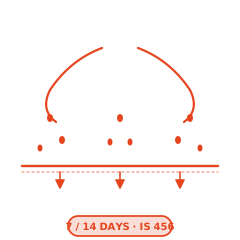
Curing water — sprinkler over concrete slab with droplets

Curing Water

Total curing water

L

Daily rate
L/day
Per m² / day
L/m²/day
Climate factor
×
IS 456 min duration
days
Water cost

Warnings

Evaporation rate from the Evaporation Rate calculator (Menzel / ACI 305R). Safety factor compensates for drift, surface roughness, and hose losses.

Application rate

kg/m²/h

L / m² / day
Total L / day
Per cycle ( h)
L

How this is calculated

Total water (Tab A): total_L = area × ratePerM2PerDay × days × climateFactor. Field rates: ponding 5, wet-hessian 4.5, spraying 3, membrane 0 L/m²/day. Climate factors: hot-dry 1.20, moderate 1.00, cool-humid 0.85. IS 456 Cl 13.5 sets minimum duration (OPC 7 d, blended 10 d) but the calculator warns rather than blocks — design intent is compliance guidance, not enforcement.

Application rate (Tab B): application = evapRate × safetyFactor. Safety factor clamped 1.0–2.0 (typical 1.25–1.50) to compensate for drift, surface roughness, and hose losses. Above 1.0 kg/m²/h is the ACI 305R plastic-shrinkage danger band.

Worked example

Total water: 100 m² slab, ponding, 14 days (PPC), moderate Pune climate. rate = 5 L/m²/day × 1.0 (moderate) = 5; daily = 500 L; total = 7,000 L over 14 days; water at ₹0.05/L = ₹350.

Application rate: Hot dry summer, evaporation 0.8 kg/m²/h (from the Evaporation Rate calc), safety 1.25 → apply 1.0 kg/m²/h — right at the ACI 305R plastic-shrinkage threshold. On 50 m², that’s 1,200 L/day via misting cycles of 15–30 min during daylight.

FAQ

How much water does concrete curing need?

IS 456 Cl 13.5 mandates ≥ 7 days for OPC and ≥ 10 days for blended / SCM cement. Field application rates (no formal IS code): ponding 5 L/m²/day, wet-hessian 4.5, spraying 3, membrane 0. Multiply by area, days, and a climate factor (hot-dry 1.2, moderate 1.0, cool-humid 0.85).

What is the plastic-shrinkage danger band?

ACI 305R/308: evaporation above 1.0 kg/m²/h is a plastic-shrinkage danger band. At this rate, surface moisture evaporates faster than bleed water can replace it — the surface dries, shrinks, and cracks before the concrete sets. Mitigations: windbreaks, sun-shades, fog misting, evaporation retarders, or continuous ponding.

What if my project uses blended cement?

IS 456 Cl 13.5 requires ≥ 10 days curing for blended / SCM cement (often 14 days in hot weather). The calculator warns when the entered duration falls short. Membrane curing alone is not recommended for SCM mixes — it traps bleed water and slows strength gain.

§ 99

Calculator companions

Often used together with this calculator — pick the next step in your design or QA loop.

Visualisation

Indicative tool — not a substitute for engineering judgement. Results are computed from formulae and reference values cited to Indian Standards and other published codes as named on this page, using nominal default assumptions; clause and table references are given in good faith for study and preliminary checks. Always verify the current edition and amendments of any cited standard in the BIS catalogue before relying on it. Final mix proportions, structural checks and construction decisions must be confirmed by a qualified engineer against the project design brief, drawings and site conditions. ConcreteInfo accepts no liability for design, procurement or construction decisions taken on the basis of these tools. Code references & rights: Indian Standards are the property of the Bureau of Indian Standards (© BIS) — official PDFs at bis.gov.in. ACI references are copyrighted by the American Concrete Institute — official documents at concrete.org. Shared in good faith as technical reference for the civil engineering fraternity — always verify against the official publication.

Deep dive: read the full significance guide — the code clauses, assumptions and site meaning behind these numbers.