
Grout Quantity Calculator

Bags of non-shrink cementitious grout for baseplate and equipment grouting — from plate size, formwork extension, grout depth and anchor-bolt pockets. Transparent arithmetic, editable typical values, no code citation (none governs grout consumption).
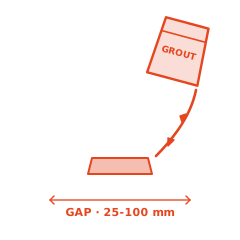
Grout quantity — base plate with column shaft above it and grout pouring into the gap beneath

Formwork normally stands off 75–150 mm past the plate so grout can flow; effective area = (L + 2×ext) × (W + 2×ext).

Set count to 0 to ignore pockets. Use the sleeve/bore diameter, not the bolt.

Typical 11–14 L per 25 kg — verify against your datasheet.

Materials required

bags of grout

Effective grouted area
Plate / pad volume
L
Anchor pockets
+ L
Net volume
L
With wastage
L
Grout mass (bag basis)
kg

How this is calculated

Effective grouted area = (plate length + 2 × extension) × (plate width + 2 × extension), or your direct formwork area. Plate volume = area × grout depth. Each anchor pocket is a cylinder, π/4 × diameter² × depth, added to the plate volume. Bags = gross volume ÷ yield per bag, rounded up.

No IS code governs prebagged grout consumption — yield per bag is a manufacturer-datasheet value. The extension, wastage and yield here are editable typical site-practice values; take mixing water strictly from the datasheet, never by guess.

Worked example

Given: pump bedplate 500 × 300 mm, formwork +100 mm all round, 50 mm grout depth, 4 bolt pockets of 60 mm dia × 300 mm deep, 5% wastage, 25 kg bags yielding 13 L.

Effective area = (500 + 200) × (300 + 200) mm = 0.7 × 0.5 = 0.35 m² → plate volume = 0.35 × 0.05 = 17.5 L

Pockets = 4 × π/4 × 0.06² × 0.3 = +3.39 L → net 20.9 L → with 5% wastage 21.9 L

Bags = 21.9 ÷ 13 = 1.69 → 2 bags of 25 kg

FAQ

How much grout for a 500 × 300 mm baseplate at 50 mm thickness?

With formwork +100 mm all round: effective area 0.7 × 0.5 = 0.35 m², volume 0.35 × 0.05 = 17.5 L. With 5% wastage and a typical 13 L yield per 25 kg bag: 2 bags. Add anchor pockets if present — four 60 × 300 mm pockets add about 3.4 L.

Why does the formwork extension matter so much?

Flowable grout must travel from the pouring side to the vent side — that needs a working margin beyond the plate. On a 500 × 300 plate, extending 100 mm all round grows the grouted area from 0.15 m² to 0.35 m², more than doubling the grout volume. Measure the actual formwork line, not the plate.

Should anchor-bolt pockets be grouted with the same grout?

Usually yes for cementitious systems — pockets and sleeves are filled in the same pour or immediately after. Their volume is a cylinder: π/4 × diameter² × depth per pocket. Use the bore/sleeve diameter; a 24 mm bolt in a 60 mm sleeve takes the 60 mm volume.

What about expansion or shrinkage allowances?

A compliant non-shrink grout is dimensionally stable — positive expansion in the plastic state, no meaningful shrinkage to compensate for in the quantity take-off. The 5% wastage here covers surface irregularity, plate tilt and formwork leakage. If your datasheet quotes a different yield-per-bag, change it in the form — the arithmetic adapts.

§ 99

Calculator companions

Often used together with this calculator — pick the next step in your design or QA loop.

Visualisation

Indicative tool — not a substitute for engineering judgement. Results are computed from formulae and reference values cited to Indian Standards and other published codes as named on this page, using nominal default assumptions; clause and table references are given in good faith for study and preliminary checks. Always verify the current edition and amendments of any cited standard in the BIS catalogue before relying on it. Final mix proportions, structural checks and construction decisions must be confirmed by a qualified engineer against the project design brief, drawings and site conditions. ConcreteInfo accepts no liability for design, procurement or construction decisions taken on the basis of these tools.

Deep dive: read the full significance guide — the code clauses, assumptions and site meaning behind these numbers.