Brass & Indian Units Converter
Convert brass to sq ft, m², sq yd, cft and m³ — with the area and volume senses kept firmly apart, because mixing them is how estimates and bills go wrong. Exact metre-based arithmetic: 1 ft = 0.3048 m.
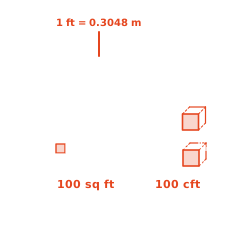
Convert brass to sq ft, m², sq yd, cft and m³ — with the area and volume senses kept firmly apart, because mixing them is how estimates and bills go wrong. Exact metre-based arithmetic: 1 ft = 0.3048 m.
Area sense: plastering, painting, flooring, formwork. Volume sense: earthwork excavation, filling, concrete.
Each dimension takes its own unit — mixed ft/m/inch entries are converted before the take-off.
Live conversion
brass
Dimensions take-off
brass
Brass is a colloquial site unit — not a statutory or IS unit. You will not find "brass" defined in any Indian Standard or in the Weights & Measures rules that govern trade units. It survives because it is convenient shorthand on Indian sites: area sense 1 brass = 100 sq ft for plastering, painting, flooring and formwork; volume sense 1 brass = 100 cft for earthwork excavation, filling and concrete. Contract documents, BOQ item descriptions and measurement books should carry sq ft / m² or cft / m³ — record brass only as a site convenience alongside the base unit, never instead of it.
Every conversion is exact arithmetic on the definition of the foot: 1 ft = 0.3048 m exactly, so 1 sq ft = 0.09290304 m² exactly, 1 cft = 0.028316846592 m³ exactly, and 1 sq yd = 9 sq ft exactly. One brass is 100 of the base unit — 100 sq ft (= 9.290304 m²) in the area sense, 100 cft (= 2.8316846592 m³) in the volume sense. The only rounded figure shown is 1 m³ = 35.3147 cft (4 decimal places of the exact ratio).
The dimensions take-off converts each of L, W (and D) from its own unit — ft, m or inch — to feet first, multiplies, and divides by 100. That is all a brass figure ever is: a hundred-count of square feet or cubic feet.
Given: an earthwork excavation pit 20 ft × 15 ft × 6 ft (volume sense).
Volume = 20 × 15 × 6 = 1,800 cft → 1,800 / 100 = 18 brass
In metric: 1,800 cft × 0.028316846592 = 50.9703 m³ (or 18 × 2.8316846592 — same answer)
Area sense for contrast: a 10 ft × 10 ft plaster patch = 100 sq ft = 1 brass = 9.290304 m² — same word, completely different quantity.
| Sense | 1 brass equals | Related exact facts |
|---|---|---|
| Area (plaster, paint, flooring, formwork) | 100 sq ft · 9.290304 m² · 11.1111 sq yd | 1 sq ft = 0.09290304 m² · 1 sq yd = 9 sq ft · 1 m² = 10.7639 sq ft |
| Volume (earthwork, filling, concrete) | 100 cft · 2.8316846592 m³ | 1 cft = 0.028316846592 m³ · 1 m³ = 35.3147 cft (4 dp) · 1 ft = 0.3048 m |
No. Brass is informal Indian site language with no definition in any Indian Standard or statutory weights-and-measures rule. It is useful shorthand — 100 sq ft or 100 cft depending on the trade — but contract documents should name sq ft/m² or cft/m³, and this tool always shows those units beside any brass figure.
Because the word carries two senses. Plastering, painting, flooring and formwork use the area sense (1 brass = 100 sq ft); earthwork excavation, filling and concrete use the volume sense (1 brass = 100 cft). Always confirm which sense a rate refers to before comparing or billing — a "rate per brass" means something nine-times different in area terms versus volume terms.
In the volume sense, 1 brass = 100 cft = 2.8316846592 m³ ≈ 2.83 m³. An M20 nominal-mix pour of 1 brass needs roughly 8 cement bags per m³ — about 23 bags — but use the nominal mix or mix design calculators for the exact bill of materials.
Often used together with this calculator — pick the next step in your design or QA loop.