
UPV Test Calculator — Velocity & Crack Depth

Ultrasonic pulse velocity from path length and transit time, graded per IS 516 (Part 5/Sec 1):2018 Table 1 — plus surface-crack depth by the transit-time method. Apply the instrument zero correction before entering readings.

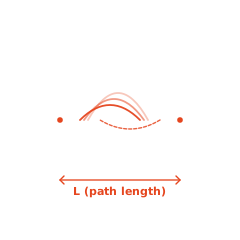
UPV velocity — two ultrasonic transducers with pulse arcs and path length L between them

Velocity & quality grade

Direct transmission preferred; note the arrangement used (direct / semi-direct / indirect).

After zero correction from the calibration bar.

Pulse velocity

km/s

Surface crack depth (transit-time method)

Same spacing L for both readings: t₁ on sound concrete, t₂ straddling the crack, transducers equidistant from it.

Estimated crack depth

mm

Sound velocity at L
km/s

How this is calculated

Velocity = path length ÷ transit time; in mm and microseconds the quotient is directly km/s. Quality grading follows IS 516 (Part 5/Sec 1):2018 Table 1: above 4.5 Excellent, 3.5–4.5 Good, 3.0–3.5 Medium, below 3.0 Doubtful (km/s).

Crack depth uses the transit-time method of BS 1881 Part 203 practice: d = (L/2) × √((t₂/t₁)² − 1) — this formula is not an IS-code provision, and it assumes an open, perpendicular crack in homogeneous concrete.

Worked example

Velocity: 500 mm direct path, corrected time 105 µs → 500/105 = 4.76 km/s → Excellent.

Crack depth: L = 300 mm, t₁ = 68.2 µs on sound concrete (v = 4.4 km/s), t₂ = 84.9 µs straddling the crack.

d = 150 × √((84.9/68.2)² − 1) = 150 × 0.742 = ≈111 mm

FAQ

What is a good pulse velocity value?

Per IS 516 (Part 5/Sec 1):2018 Table 1:>4.5 km/s Excellent · 3.5–4.5 Good · 3.0–3.5 Medium · <3.0 Doubtful. The grade reflects density and homogeneity — good concrete, well compacted, no honeycombing. It does not read strength directly; correlate with cubes or cores for that.

Does a higher velocity mean higher strength?

Broadly correlated, but not reliably convertible — moisture, age, aggregate type and temperature all shift velocity without the same shift in strength. That is why IS 516 (Part 5/Sec 1):2018 grades quality, not grade of concrete. Use UPV for uniformity mapping across a member and spot-check anomalies with cores.

Which transducer arrangement should I use?

Direct (opposite faces) gives the truest path and is preferred. Semi-direct (adjacent faces) is acceptable; indirect (same surface) under-reads velocity by roughly 5–10% and is mainly used for crack depth and surface-layer surveys. Note the arrangement with every reading.

When does the crack-depth method fail?

When the crack is not open (tight or water-filled — no delay to measure, t₂ ≤ t₁), not perpendicular to the surface, when reinforcement lies between the transducers, or when the depth approaches the spacing. Treat the result as an estimate to confirm, not a measurement.

§ 99

Calculator companions

Often used together with this calculator — pick the next step in your design or QA loop.

Visualisation

Indicative tool — not a substitute for engineering judgement. Results are computed from formulae and reference values cited to Indian Standards and other published codes as named on this page, using nominal default assumptions; clause and table references are given in good faith for study and preliminary checks. Always verify the current edition and amendments of any cited standard in the BIS catalogue before relying on it. Final mix proportions, structural checks and construction decisions must be confirmed by a qualified engineer against the project design brief, drawings and site conditions. ConcreteInfo accepts no liability for design, procurement or construction decisions taken on the basis of these tools. Code references & rights: Indian Standards are the property of the Bureau of Indian Standards (© BIS) — official PDFs at bis.gov.in. BS/EN references are copyrighted by BSI and CEN — bsigroup.com. Shared in good faith as technical reference for the civil engineering fraternity — always verify against the official publication.

Deep dive: read the full significance guide — the code clauses, assumptions and site meaning behind these numbers.
§ 99

Calculator companions

Often used together with this calculator — pick the next step in your design or QA loop.