
Cube Test Log

A daily logbook for cube test results — log each 150 mm cube as you test it, and the IS 456:2000 Table 11 verdicts, rolling group-of-four monitoring, per-grade statistics and CSV export build themselves. Your data never leaves this browser.

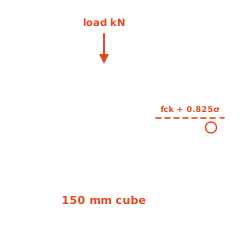
Cube test log — a 150 mm test cube beside a rising strength trend line with a dashed acceptance threshold

Log a cube result

One entry = one 150 mm cube. Cubes sharing a specimen ref and cast date form one sample (a set of three cubes); the group monitors below work on those sample results, four at a time.

days pick both dates

Live strength: = load × 1000 / (150 × 150) mm², i.e. load / 22.5

No cubes logged yet. Add your first result above — verdicts, group monitors, statistics and the trend chart build themselves as the log grows.

Log — cubes

SrCastTestedAgeGradeRefLocationLoad kNN/mm²DensityVerdictActions

Individual verdict per IS 456:2000 Table 11 — PASS at or above fck; MARGINAL when the result clears the fck − 3 floor but sits below grade strength; FAIL below fck − 3. Screen dates are DD/MM/YYYY; the CSV export uses ISO dates.

Group monitoring — IS 456 Table 11

Per grade: non-overlapping groups of four consecutive sample results, each judged against fck + max(0.825σ rounded to the nearest 0.5, 3); the rolling last-4 line is an early-warning view of the current trend. σ is the Table 8 assumed value until a site σ from 30+ results is established.

Statistics per grade

Over all cube results logged for the grade. σ is the sample standard deviation (n − 1 basis); CV = σ / mean × 100.

GradeCubes nSamplesMean N/mm²σ (n−1)CV %MinMax

This log is for 150 mm cubes only. The strength divide is fixed at the standard 150 × 150 mm loaded face of the IS 10086 specimen, tested per IS 516 — there is no 100 mm cube option and no size correction factor in this tool, because none is verified for it. If your laboratory tests 100 mm cubes, keep those in your laboratory register under the correction your specification mandates, and log only the 150 mm results here. Cube mass, if entered, is used solely to show density (mass / 3,375 cm³) as handling information — it plays no part in any verdict.

Your log stays in this browser. Entries are saved to this browser's localStorage under the key ci_cube_log_v1 and are never uploaded, synced or sent anywhere — there is no server behind this page. Clearing your browser data for this site erases the log, so export a CSV for your permanent records. It is a daily convenience logbook, not your statutory register.

How this is calculated

Cube strength is load × 1000 / (150 × 150) N/mm² — for load in kN, simply load / 22.5 (450 kN → 20.0 N/mm²). Age is the calendar-day difference between the two dates, with 7, 28, 56 and 90 days highlighted as the standard test ages.

Acceptance follows IS 456:2000 Table 11 as amended through Amendment 4, the same verified numbers as our Cube Test Statistics calculator: each group of four non-overlapping consecutive sample results must average at least fck + max(0.825σ rounded to the nearest 0.5, 3), and every individual result must be at least fck − 3. The 0.825σ term is rounded to the nearest 0.5 before adding to fck — as fck is always a whole number, this equals rounding the sum (M20 with σ 4.0: 3.3 → 3.5 → 23.5 N/mm²).

A sample is the set of cubes sharing a specimen ref and cast date — three cubes by IS 456 Cl 15.2.2 practice — and its result is the mean of those cubes (IS 516). Groups are four such sample results taken consecutively in sampling order; the rolling last-4 monitor applies the same limit to the four most recent samples as an early warning. The σ used is the Table 8 assumed value — 3.5 (M10–M15), 4.0 (M20–M25), 5.0 (M30+) N/mm² — which the code permits until a site σ from 30+ results is established. Small-pour rules (≤30 m³, fewer than four samples: mean ≥ fck + 4, individual ≥ fck − 2) are shown as a note only and are not auto-applied.

On-screen numbers use Indian formatting and DD/MM/YYYY dates; the CSV export carries plain numbers and ISO dates so spreadsheets and registers read them without re-parsing.

Worked example

Given: M20 concrete, four samples cast a week apart, sample results 26.4, 25.9, 27.1 and 26.0 N/mm² — each the mean of three cubes logged here with the same specimen ref and cast date. No established σ, so Table 8 gives σ = 4.0.

Group limit: 0.825 × 4.0 = 3.3 → rounded to the nearest 0.5 → 3.5, which exceeds the fck + 3 = 23 floor, so the group mean must be ≥ 23.5 N/mm².

Group mean = (26.4 + 25.9 + 27.1 + 26.0) / 4 = 26.35 N/mm² ≥ 23.5 → conforms, and every cube clears the individual floor of 20 − 3 = 17 N/mm².

Contrast: a week of poor control giving sample results 19, 18.5, 20, 19.5 → group mean 19.25 < 23.5 → the log flags the group FAIL and the rolling monitor drops with it — the moment to investigate batching and curing, well before the 28-day record closes.
Quick reference

Criterion (IS 456:2000 Table 11, Amd 4)RuleWhere it appears
Individual result ≥ fck − 3 N/mm² Verdict column on every logged cube
Group of four consecutive samples mean ≥ fck + max(0.825σ rounded to nearest 0.5, 3) Group monitoring panel — non-overlapping groups plus rolling last-4
Assumed σ until site-established (Table 8) M10–M15: 3.5 · M20–M25: 4.0 · M30+: 5.0 N/mm² Applied per grade; swap in an established σ via Cube Test Statistics
Small pour (≤30 m³, fewer than 4 samples) mean ≥ fck + 4 · individual ≥ fck − 2 · single sample ≥ fck + 4 Listed as a note when a grade is below four samples — not auto-applied
Standard test ages 7 · 28 · 56 · 90 days highlighted Age column and entry-form preview
  • Specimen: 150 mm cubes per IS 10086 shapes, tested per IS 516 — no other size is accepted by this log.
  • Density from mass: optional cube mass ÷ 3,375 cm³ gives kg/m³ — compaction and handling information only.
  • Records: export the CSV (ISO dates, plain numbers) for your register; this browser log is the working copy, not the statutory record.

FAQ

Why does the log accept only 150 mm cubes?

The strength here is load divided by the 150 × 150 mm face, the standard specimen for structural concrete (shapes per IS 10086, testing per IS 516). A 100 mm cube needs a size-correction factor to compare with it, and no such factor is verified in this tool's reference ledger — so the page keeps one honest denominator instead of an unverified conversion. Test 100 mm cubes in your laboratory register under the correction your specification mandates, and log the 150 mm results here.

What is one entry, one sample and one group?

One entry is one cube. A sample is every cube sharing the same specimen ref and cast date — three cubes by IS 456 Cl 15.2.2 practice — and its result is the mean of those cubes per IS 516. A group is four consecutive sample results in sampling order, which is what Table 11 judges; the rolling monitor shows the same judgement on the latest four as an early warning.

When do the assumed σ values stop applying?

Table 8's assumed values (3.5 / 4.0 / 5.0 N/mm²) hold until a σ established from 30 or more results on your site exists. Once your log or register carries that history, compute the established σ and use the Cube Test Statistics calculator with it entered — the log's per-grade σ row in the statistics table is the n − 1 sample value you can carry over.

A group failed — does the concrete come out?

Not automatically. A failed Table 11 check triggers investigation, not instant rejection: IS 456 Cl 16.4 permits assessment of the actual structure — typically non-destructive testing (UPV, rebound hammer) or core extraction per IS 516 Part 4 / IS 456 Cl 17. The failure report should prompt an investigation of batching, sampling and testing before any removal decision.

§ 99

Calculator companions

Often used together with this calculator — pick the next step in your design or QA loop.

Strength trend

Each point is one logged cube; dashed lines mark the Table 11 group-of-4 acceptance level per grade.

Indicative tool — not a substitute for engineering judgement. Results are computed from formulae and reference values cited to Indian Standards and other published codes as named on this page, using nominal default assumptions; clause and table references are given in good faith for study and preliminary checks. Always verify the current edition and amendments of any cited standard in the BIS catalogue before relying on it. Final mix proportions, structural checks and construction decisions must be confirmed by a qualified engineer against the project design brief, drawings and site conditions. ConcreteInfo accepts no liability for design, procurement or construction decisions taken on the basis of these tools. Code references & rights: Indian Standards are the property of the Bureau of Indian Standards (© BIS) — official PDFs at bis.gov.in. Shared in good faith as technical reference for the civil engineering fraternity — always verify against the official publication.

Deep dive: read the full significance guide — why a running log beats one-shot statistics and what rolling group-of-four compliance looks like in practice.